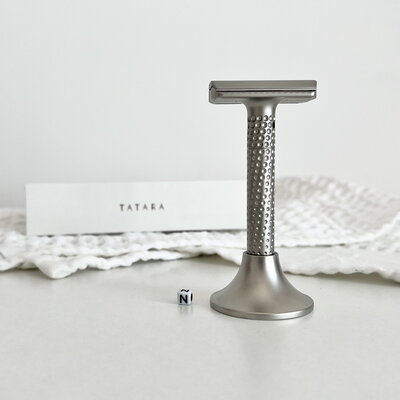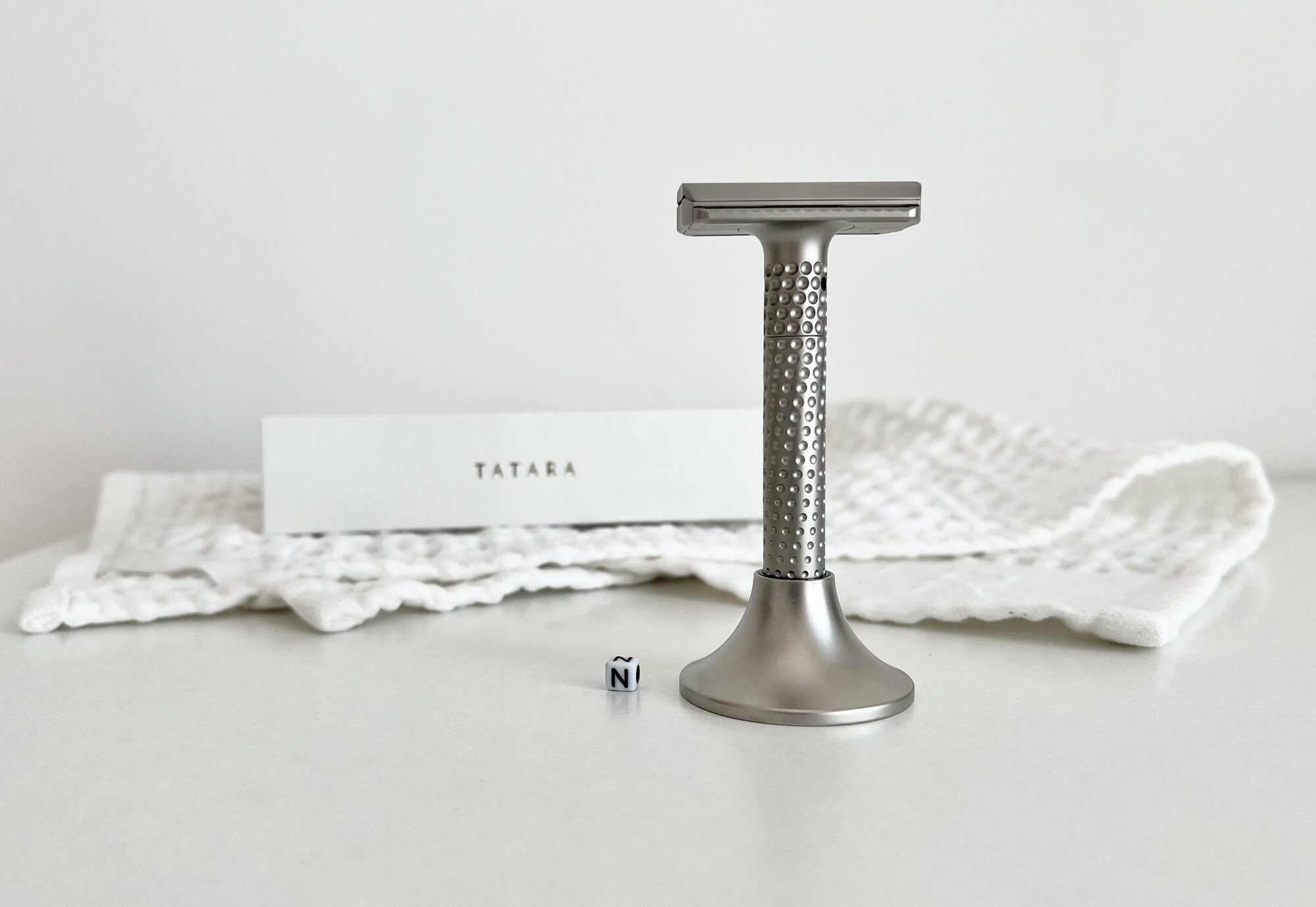
The brand name and each model’s design tell a story that refers back to old samurai traditions. The smelting furnaces where swordsmiths hardened their alloys were called «tatara». That word gave the Portuguese company its name when it was founded in 2016. The appearance and construction of the razors are inspired by the legendary swordsmiths of ancient Japan, where steel symbolized precision, honor, and craftsmanship.
Tatara Masamune
This three-piece safety razor was Tatara’s first creation and is named after the legendary 13th-century Japanese swordsmith Masamune Okazaki-the greatest Japanese sword master, whose blades were famed for unmatched balance and workmanship. His forging method was used for centuries. In Japan there is even a national prize for top swordsmiths named after Masamune.
The Masamune razor is made of stainless steel and has a special construction that sets it apart from competitors. Thanks to a unique head-mounting system-not only with threads but also two internal sliders-the head is held perpendicular to the handle, and the handle sinks into the top cap when tightened. In this design the head sits at a 24° angle relative to the skin during shaving. That allows the blade to work very close to the face or body: stubble is cut right near the skin, and sharp «stubble nubs» aren’t felt.

Because the wide parts of the plates that surround the blade secure it tightly, the blade remains motionless during shaving. The absence of vibration prevents skin irritation.
The entire surface of the Masamune razor is smooth and free of rough spots. It is finely finished by hand and then given a sandblasted finish that gives the surface a perfect, completed look.
Masamune is produced with both open and closed cuts. They differ in exposure (the blade’s protrusion relative to the shaving plane) and in blade gap (the distance between the base plate and the blade).
The razor with the closed cut has a gap of 0.63 mm and a negative exposure (-0.13 mm). The open-headed version has a gap of 0.73 mm and an exposure that is still negative but closer to neutral (-0.1 mm). The larger the gap and blade exposure, the more aggressive the razor and the higher the chance of nicks. The Masamune’s larger gap makes it efficient, while its negative exposure keeps it non-aggressive.
Tatara Masamune Closed Comb — MatteTatara Masamune Nodachi
The razor named after the large two-handed Nodachi sword-designed for long-range strikes and unsurpassed power-has a longer handle for better control while shaving.
Tatara Masamune Nodachi is suited to coarser stubble than the Masamune. The razors differ slightly in size. Masamune Nodachi is 108 mm long with a handle diameter of 12.5 mm. The Masamune is 93.7 mm long with an 11 mm handle diameter.
The blade exposure on the Masamune Nodachi is positive: it extends 0.13 mm beyond the shaving plane, and the blade gap is 0.9 mm-making the Nodachi more aggressive than the Masamune.
The Masamune Nodachi is offered with both closed and open cuts. The closed-cut head has grooves along the sides of the plate, so the chance of nicks is lower than with the open-cut version. The open comb, however, handles coarse and longer stubble better. The base plate has a slightly recessed shape, so it stays close to the skin during shaving and removes stubble effectively.
All parts of the Masamune and Masamune Nodachi razors are interchangeable. Changing their arrangement alters the razors’ parameters. Possible blade exposure values (in mm) are shown in the table.
| Masamune Closed cut, gap 0.63 mm | Masamune Open cut, gap 0.73 mm | Nodachi Closed or open cut, gap 0.9 mm | |
| Masamune top cap | -0,13 | -0,1 | -0,03 |
| Masamune Nodachi top cap | 0,00 | 0,05 | 0,13 |
The greater the blade exposure value, the more aggressive the shave will be. You can tune the shave by combining top caps and base plates. For example, move the closed-cut base plate from the Masamune to one with an open cut — the exposure becomes (-0.1 mm), and if you replace it with the Masamune Nodachi open comb, the exposure will be slightly larger (-0.03 mm). Choose the parameters depending on how long your stubble has grown.
Tatara Masamune Nodachi Closed Comb — MatteTatara Muramasa
According to legend, the Muramasa name belonged to a dynasty of swordsmiths in ancient Japan. They made unique blades whose sharpness both amazed and frightened people-some even called them «bloodthirsty," craving battle.
The multifunctional Muramasa razor is equally relentless toward its «enemy»-stubble. But this tool, with a closed cut and an adjustable aggressiveness level, is controlled by the samurai-that is, you. You can change the aggressiveness level with a light movement of the hand, literally on the fly. There’s no need to disassemble the razor; simply turn the dial to choose the desired setting.
Level 1 is designed for fine stubble and hair, for users with sensitive skin and for those who enjoy daily shaving. It’s suitable for beginners and for those switching from cartridge razors to DE safety razors. Depending on stubble length, texture and thickness, aggressiveness is adjusted from 1 to 5, with intermediate levels available as well.
The razor’s uniqueness is that you can change both the gap and the blade exposure at the same time. This is possible thanks to a unique construction of sliding plates. When you rotate the dial and set it to one of the five numbers, the top and base plates shift relative to the blade-this adjusts both exposure and gap.
The gap ranges from 0.6 to 0.9 mm. Blade exposure can be negative, neutral, or positive. The sliding base plates allow quick changes of gap and exposure.
| Mode number | Gap | Exposure |
| Mode 1 | 0.60 mm | -0.17 |
| Mode 2 | 0.70 mm | -0.07 |
| Mode 3 | 0.75 mm | 0 |
| Mode 4 | 0.8 mm | 0.07 |
| Mode 5 | 0.9 mm | 0.17 |
The Muramasa aggressiveness adjustment system is patented.
Another constructive feature is the shape and size of the head. It’s narrow with smoothly rounded corners, which provides comfort during shaving. The head easily reaches under the nose and near the earlobes without causing injury. For user safety, the blade’s side protrusions are reliably hidden under the base plate.
A strong point of the Tatara Muramasa is that the blade does not vibrate or bend during shaving because it is firmly clamped between flat plates. The absence of blade vibration protects against nicks and catching the stubble, so the risk of irritation is virtually zero. The planes that hold the blade match its dimensions, so the blade is perfectly clamped and does not deform in use.
The razor is made from 316L stainless steel, an extra-strong alloy resistant to seawater and corrosion thanks to added molybdenum. All seven parts are produced on CNC machines, allowing minimal tolerances of 0.02 mm. All parts are given a sandblasted finish-maximally smooth and flawless. The handle is grippy, with small dimples along its length whose diameter decreases toward the head. There are no springs inside the razor, as in many other adjustable razors; instead a dial is installed, which makes the razor more durable and robust.

Despite the construction features, care of the razor is simple. Rinse the razor under a normal stream of water and dry it with a lint-free towel. Periodically perform a full disassembly for thorough cleaning. Use the key supplied in the kit for this. With the included tool you can unscrew the razor and clean it completely from the inside.
Tatara MuramasaTatara Amakuni
Tatara’s first razor for single-edge blades was named after the legendary blacksmith Amakuni Yasutsuna, who is believed to be at the origin of the samurai’s curved long sword.
Amakuni has a simple, elegant design; smoothly curved parts provide a nimble and precise shave. Blade installation is as easy as can be, even for a beginner, because the connection mechanism between the top cap and the blade uses magnets. This practical, compact design simplifies assembly and makes shaving more comfortable. Thanks to the magnet, the blade vibrates less, which reduces the risk of cuts. The ultra-thin head easily shaves in hard-to-reach areas-under the nose and near the earlobes. The blade angle of 29 degrees allows effective stubble removal. The gap (the distance between the top and bottom plate) is 0.85 mm. Such a gap is usually found on aggressive razors, but since the blade exposure is only 0.06 mm, the risk of injury is low.
All Artist Club blades (except green Feather Light blades) fit the Amakuni, and the choice of blade slightly affects aggressiveness. So the razor can be used by beginners-with gentle, low-aggression blades (Kai Captain Titan Mild Pink, Kai Captain Titan Mild Protouch, Feather Professional Light, etc.)-as well as by experienced users with coarse stubble when using, for example, Feather Professional or Feather Professional Super. The handle, as with other Tatara razors, has 294 dimples on its surface-they are arranged so that the razor sits comfortably in the hand and does not slip. The top of the handle is slightly curved to provide increased comfort and control during shaving.
Tatara AmakuniTatara razors seem to cover the entire spectrum of shaving needs, but the company continues to develop new tools to make your shaving even easier and more enjoyable. Whatever comes next, we’ll be sure to describe it in this article and add it to our catalog.